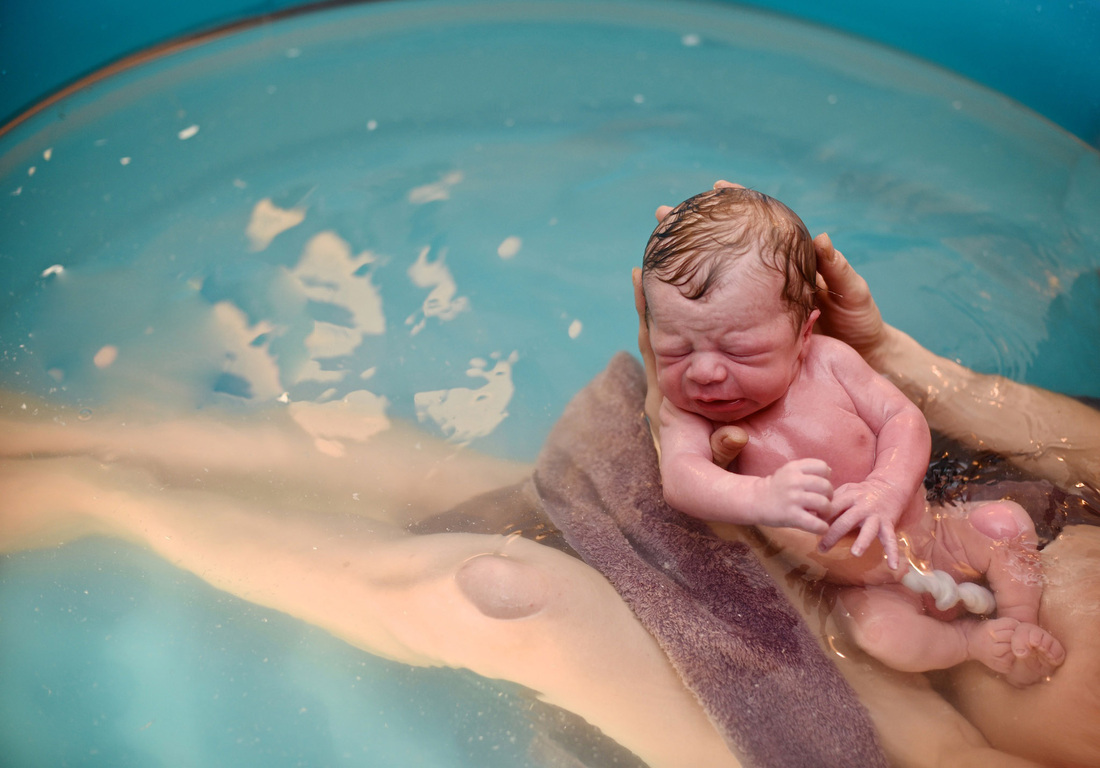
For decades, giving birth in water has remained one of the most debated choices in modern maternity care. Some women describe warm water as calming and comforting during labor, while others remain concerned about what could happen when a baby is actually born underwater.
The debate is understandable. Childbirth is unpredictable, and when a method involves something as unusual as delivering a baby in a pool filled with warm water, even small potential risks can become a major concern.
But what happens when researchers stop looking at individual cases and instead examine tens of thousands of births?
That is exactly what a team of researchers from Oregon State University set out to do.
Their study became one of the largest investigations of water birth conducted to date. Instead of focusing on a handful of hospitals or several hundred patients, the researchers examined data involving more than 35,000 women across the United States.
And the results were more complicated than either side of the water-birth debate might have expected.
Why do women choose to give birth in water?
The basic idea behind water birth is surprisingly simple.
During labor, a woman enters a pool filled with warm water. The warmth can provide comfort and may help her cope with contractions. Some women prefer the feeling of being supported by the water rather than lying on a traditional delivery bed.
Water immersion has also been associated with reduced discomfort during labor and, in some circumstances, a lower need for pain medication.

But there has always been an important distinction between laboring in water and actually giving birth in water.
Some hospitals allow a woman to spend part of labor in a pool but ask her to leave before the baby is born. The reasoning is straightforward: if there are concerns about the safety of delivering underwater, removing the mother from the pool before delivery appears to be the more cautious option.
The researchers wanted to examine whether that extra step was always necessary.
A remarkably large group of women
To investigate the question, researchers analyzed 35,060 births involving healthy women with uncomplicated singleton pregnancies.
Half of the women — 17,530 — gave birth in water. The same number gave birth without water.
The researchers did not simply compare the two groups and stop there.
They considered more than 80 demographic characteristics and potential risk factors, including factors such as age and education. The purpose was to make the comparison more meaningful and reduce the possibility that differences between the groups were caused by other characteristics.
Importantly, the study focused on pregnancies without certain complications. Women with conditions such as gestational diabetes or breech presentation were not included in the analysis.
That means the findings cannot simply be applied to every pregnancy.
But within the group studied, the results were striking.
The result that surprised researchers
According to the study, water birth was associated with outcomes that were generally similar to, or in some cases better than, conventional birth.
One particularly important measure was neonatal mortality. The researchers did not find an increased risk associated with water birth; the reported risk ratio was 0.56.
The analysis also looked at hospitalization of the mother or baby during the first six weeks after birth. Again, the researchers did not find evidence of an overall increase in this outcome. The reported risk ratio was 0.87.
There was another finding that attracted attention.
Women who gave birth in water experienced fewer cases of bleeding, with the researchers estimating 64 fewer cases per 10,000 pregnancies.
For supporters of water birth, these findings may appear reassuring.
But the study did not provide a simple “water is safer” conclusion.
There were risks that went in the opposite direction.
The risks did not disappear
The researchers identified a somewhat increased risk of umbilical cord vessel rupture among water births. The reported risk ratio was 1.57.
They also observed a small increase in postpartum uterine infections, equivalent to approximately six additional cases per 10,000 births compared with births without water.
At the same time, the researchers did not find an increased risk of hospitalization because of infection. Nor did they identify infant deaths caused by umbilical cord rupture in the study data.
These details are important because they show why medical research rarely produces a simple answer such as “safe” or “dangerous.”
A procedure can be associated with lower rates of some outcomes while carrying a higher risk for others.
So, is water birth actually safe?
This is where the findings become particularly interesting.
The researchers themselves were careful not to describe water birth as universally safe or appropriate.
Their conclusion was more nuanced: the findings were consistent with previous research suggesting that water birth may not be as harmful as some recommendations imply, but it also should not be presented as completely risk-free.
That distinction matters.
A large study can provide stronger evidence than a small collection of individual stories, but it still cannot determine that one method is appropriate for every woman.
Pregnancy is not a single standardized experience. Age, pregnancy history, medical conditions, fetal position, complications and many other factors can influence the safety of different approaches to delivery.
The biggest finding may not be what people expected
For years, discussions about water birth have often been divided into two opposing ideas.
One side emphasizes the potential comfort and benefits of warm water. The other focuses on possible complications associated with delivering a baby underwater.
The new evidence suggests that reality sits somewhere between those extremes.
For the healthy, uncomplicated pregnancies examined in this large American study, water birth was not associated with the dramatic increase in serious adverse outcomes that some people might fear.
At the same time, it was not completely free of potential complications.
And that may be the most important message from the research.
The study does not say that every woman should give birth in water. It does not establish that water birth is safer for every pregnancy. Instead, it adds a very large amount of data to a debate that has often been dominated by smaller studies and strong opinions.
For some women with uncomplicated pregnancies, giving birth in warm water may therefore be a possible option worth discussing with their maternity-care team.
For others, different circumstances may make another approach more appropriate.
In the end, the largest study of water birth did not produce a simple winner between water and traditional delivery.
It produced something more useful: evidence suggesting that water birth may be neither the dangerous experiment its critics sometimes portray nor the completely risk-free experience its strongest advocates might suggest.
And that middle ground is precisely what makes the findings so significant.