At first, it sounds like the beginning of a joke.
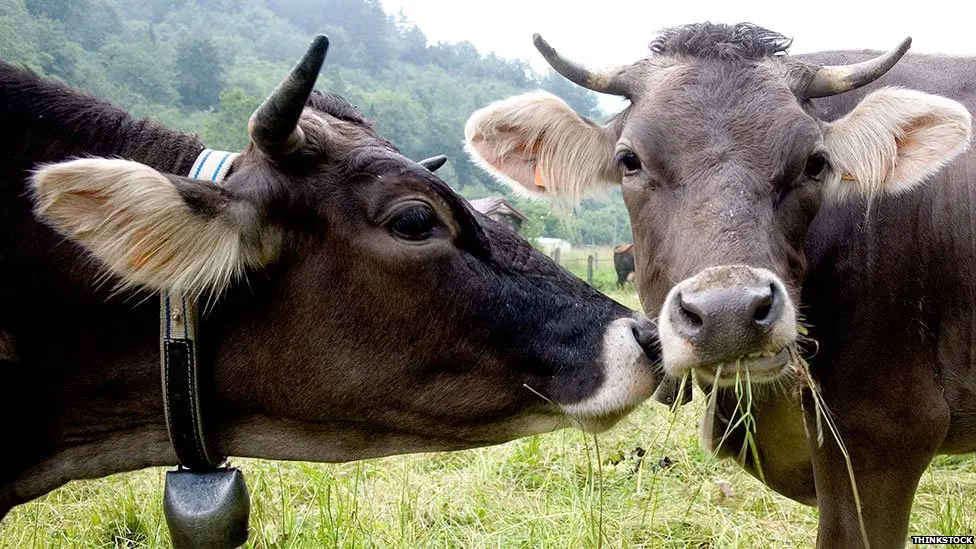
A cow eats grass, chews its food, stands quietly in a field — and then burps.
Nobody normally thinks twice about it. After all, cows burp. That is simply what cows do.
But scientists discovered that those ordinary-looking burps are connected to a much bigger story — one involving the food on supermarket shelves, climate change and even the price people could eventually pay for a steak.
The surprising part is that the burp itself is not really the problem. The important detail is what comes out with it.
Cows are ruminants, which means their digestive systems work very differently from ours. Inside their stomachs, communities of bacteria help break down the food they eat. During this process, methane is produced. The cow eventually releases that methane, mainly through burping.
Methane is a greenhouse gas. Like carbon dioxide, it can contribute to warming by trapping heat in the atmosphere. In fact, the research explained that methane has a much higher warming potential than carbon dioxide when the gases are compared over the relevant time frame used in the study.
And suddenly, an ordinary cow standing peacefully in a field becomes part of a much larger calculation.
Scientists wanted to understand just how large that calculation could become.
They did not simply count cow burps.
Instead, researchers used a method called life cycle assessment. This means looking at the emissions associated with a product throughout its entire journey — from producing the raw materials and raising the animals to transportation, refrigeration, packaging and cooking.
For beef, that means considering much more than the cow itself.
There are emissions associated with growing feed, transporting cattle, processing meat, moving it to stores, keeping it refrigerated and preparing it at home.
The researchers also included methane released by the animals.
Wheat has its own environmental costs. Farmers need machinery, fuel and fertilizers, while harvested wheat also has to be transported, packaged and processed.
So this was not simply a competition between “cows” and “plants.”
It was a calculation of two complete food-production systems.
And this is where the numbers became surprisingly large.
According to the study summarized by Science Journal for Kids, producing one pound of beef was associated with about 30 pounds of carbon dioxide equivalent emissions, while producing one pound of wheat was associated with about one pound.
That difference becomes even more striking when millions of pounds of food are involved.
Using U.S. consumption and production data from 2010, the researchers estimated that beef production was responsible for roughly 800 billion pounds of carbon dioxide equivalent emissions, compared with about 130 billion pounds associated with wheat.
But there was another question hiding behind all those numbers.
What happens if society decides that greenhouse-gas emissions should have a financial cost?
Climate change itself is not free. Extreme weather can damage homes and infrastructure, drought can affect agriculture, and communities may have to spend money dealing with environmental consequences.
Because of this, governments have considered systems in which businesses pay fees associated with their carbon emissions.
If such a system were applied to food production, farmers and producers could face additional costs.
And those costs could eventually reach the supermarket.
The study examined possible carbon fees ranging from $10 to $85 per ton of carbon. Using its estimates, the total potential carbon cost associated with U.S. wheat production in 2010 ranged from roughly $600 million to $5 billion, while the estimated range for U.S. beef production was approximately $3.5 billion to $30 billion.
But the biggest surprise comes when those figures are translated into something much easier to understand.
The price of bread and the price of beef would not necessarily rise by the same amount.
According to the study, the additional cost for wheat could amount to no more than about 5 cents per pound, while beef could become as much as $1.50 more expensive per pound under the carbon-fee assumptions examined by the researchers.
That would represent a possible increase of up to about 40% for beef, compared with a much smaller potential increase for wheat.
And that is the twist hidden behind the seemingly ridiculous question about cow burps.
The researchers were not really asking how much money a single cow should pay for burping.
They were asking something much bigger: how much does the environmental impact of producing our food actually cost?
The answer cannot be found by looking at a cow standing in a field.
It has to be calculated across the entire journey from farm to dinner table.
A steak may look like a simple item on a supermarket shelf, but behind it is a long chain of feed production, farming, transportation, refrigeration, processing and cooking — along with methane produced during the animal’s digestion.
And that is why the innocent-looking “burp” suddenly becomes part of an economic calculation worth billions of dollars.
Perhaps the strangest part of the story is that cows are not doing anything unusual.
They are simply digesting their food in the way their biology evolved to do.
Yet that ordinary biological process can have consequences far beyond the pasture.
So the next time someone laughs at the question, “How much does it cost when a cow burps?”, the answer is surprisingly complicated.
It is not about putting a price tag on one burp.
It is about understanding that something as ordinary as a cow eating grass can eventually become part of a global calculation involving greenhouse gases, food production, climate costs and the price of what we eat.
And according to the research, when all those numbers are finally added together, the humble cow turns out to have a much bigger economic story behind its seemingly harmless “burp.”
Посмотреть эту публикацию в Instagram