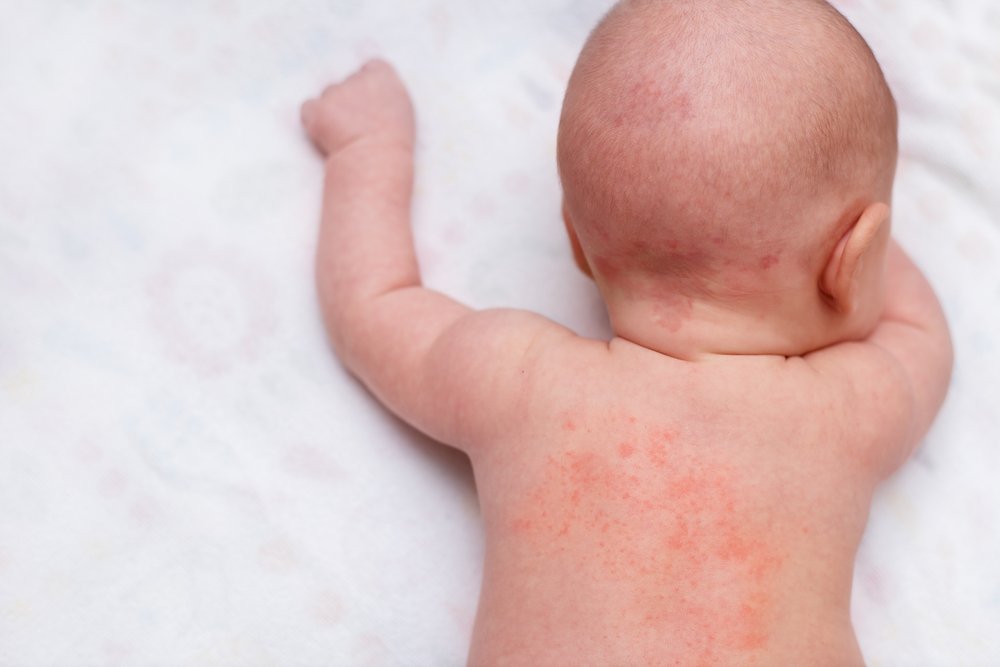
Few things can make new parents nervous faster than noticing something unusual on their baby’s skin. One day, the skin looks perfectly smooth and soft. The next, there may be red patches, tiny bumps, dryness or irritated areas that seem to have appeared out of nowhere.
The first thought is often the same: Is this an allergy?
Sometimes it is. But the situation is rarely as simple as looking at a rash and immediately identifying its cause. Babies have particularly delicate skin, while their immune and digestive systems are still developing. As a result, things that seem completely ordinary to an adult can sometimes cause an unexpected reaction in a very young child.
And this is where the real mystery begins.
Why does a baby suddenly develop a rash?
According to the source article, allergic reactions in infants can have several possible triggers. Food is one of the possibilities, particularly when a baby is breastfed. Substances from foods eaten by the mother can pass into breast milk, which means that parents may sometimes need to look carefully at the mother’s diet when investigating a suspected reaction.
Cow’s milk protein is another possible trigger. Some infants can react to it, and special formulas may be recommended for babies who cannot tolerate standard formula. For breastfed babies, doctors may recommend that the mother temporarily avoids dairy products if cow’s milk protein allergy is suspected.
But food is far from the only possible explanation.
Household dust, pollen and animal fur can also be associated with allergic reactions. The source notes that reducing exposure to potential allergens and maintaining careful household cleaning may help in situations where environmental triggers are suspected.
There is also another possibility that is easy to overlook: something touching the baby’s skin.
Sometimes the problem is much closer than parents expect
A baby’s skin comes into contact with clothing, bedding, washing products, creams and other materials every day.
Synthetic or wool fabrics, brightly dyed materials, cosmetics and traces of laundry detergent can potentially irritate sensitive skin. A contact reaction may appear after the skin has been exposed to a particular substance and may improve after that contact stops.
This can make identifying the cause surprisingly difficult.
Imagine changing a baby’s clothes, washing the bedding, using a new cream and introducing a different detergent within the same week. If a rash appears, which one caused it?
That is precisely why parents should be careful about trying to identify an allergen based solely on appearance.
The skin can tell a story — but it does not always tell the whole story
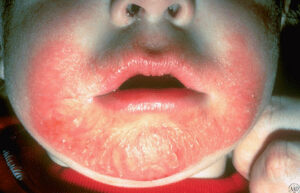
Redness, dryness, itching and small cracks can accompany irritated skin. For a baby, even a relatively small area of discomfort can become troublesome because scratching or rubbing may further damage the skin.
This creates a frustrating cycle.
The skin becomes irritated. The baby feels uncomfortable. The baby rubs or scratches the area. The skin becomes even more sensitive.
Parents naturally want to stop the process as quickly as possible.
However, the source emphasizes that medication for infants should not be chosen independently. Even medicines considered ordinary for older children or adults may not be appropriate for a newborn or young baby.
That is why a pediatrician or another qualified healthcare professional should determine whether the symptoms really represent an allergy and whether treatment is necessary.
Not every rash means that a baby needs medication
This is one of the details that can surprise anxious parents.
The source explains that some allergic skin reactions in children under one year may disappear without specific medication. The appropriate approach depends on the cause, severity and individual circumstances.
In other words, seeing a rash does not automatically mean that parents should reach for a medicine cabinet.
At the same time, “wait and see” should not mean ignoring symptoms. A persistent, spreading or severe rash deserves professional assessment, especially if the baby seems unwell or develops other symptoms.
The appearance of a rash can overlap with many different childhood skin conditions, and distinguishing between them is not always possible from a photograph or description alone.
The most important part may actually be the simplest
While parents are often focused on discovering what caused the rash, another question is equally important:
How can the baby’s skin be protected while the problem is being investigated?
Gentle skin care can be an important part of managing irritation. Keeping the skin clean without excessive washing, avoiding unnecessary products and choosing gentle fabrics can reduce additional irritation.
The source also discusses moisturizing and specialized skin-care products for babies with irritated or dry skin. However, individual products are not appropriate for every child, so parents should consider professional advice when symptoms are persistent or severe.
There is another reason gentle care matters.
When irritated skin becomes very dry, tiny cracks can develop. Damaged skin is more vulnerable to further irritation, which can make the original problem appear worse than it was at the beginning.
And then comes the question every parent wants answered
What exactly caused the reaction?
That answer can sometimes take time.
A food ingredient, milk protein, household substance, fabric, cosmetic product or environmental factor may be involved. In other cases, what looks like an allergy may have another explanation entirely.
This is why changing everything at once can make the mystery even harder to solve. Careful observation and professional evaluation can be more useful than simply removing dozens of things from a baby’s environment.
And there is one final detail that parents should remember.
A baby’s rash is not necessarily a sign that something dangerous has happened.
Infant skin is extraordinarily sensitive, and many skin problems are temporary. Some reactions may disappear as the child grows and the immune and digestive systems mature.
But the opposite is also important: parents should not automatically assume that every rash is “just an allergy.”
The most reassuring approach is not to panic at the first red spot — but neither is it to ignore a persistent or unusual reaction.
The real answer often lies not in the rash itself, but in what happened shortly before it appeared: what the baby ate, what touched the skin, what changed in the household and how the symptoms developed over time.
And that may be the biggest lesson of all.
When it comes to a baby’s sensitive skin, the most important clue may be the one parents initially overlook: not how the rash looks, but what changed just before it appeared.