When Bente Mauritzen looked in the mirror after leaving the cosmetic clinic, she immediately knew something was wrong.
She had expected a cosmetic treatment. Instead, the woman looking back at her appeared almost unrecognizable.
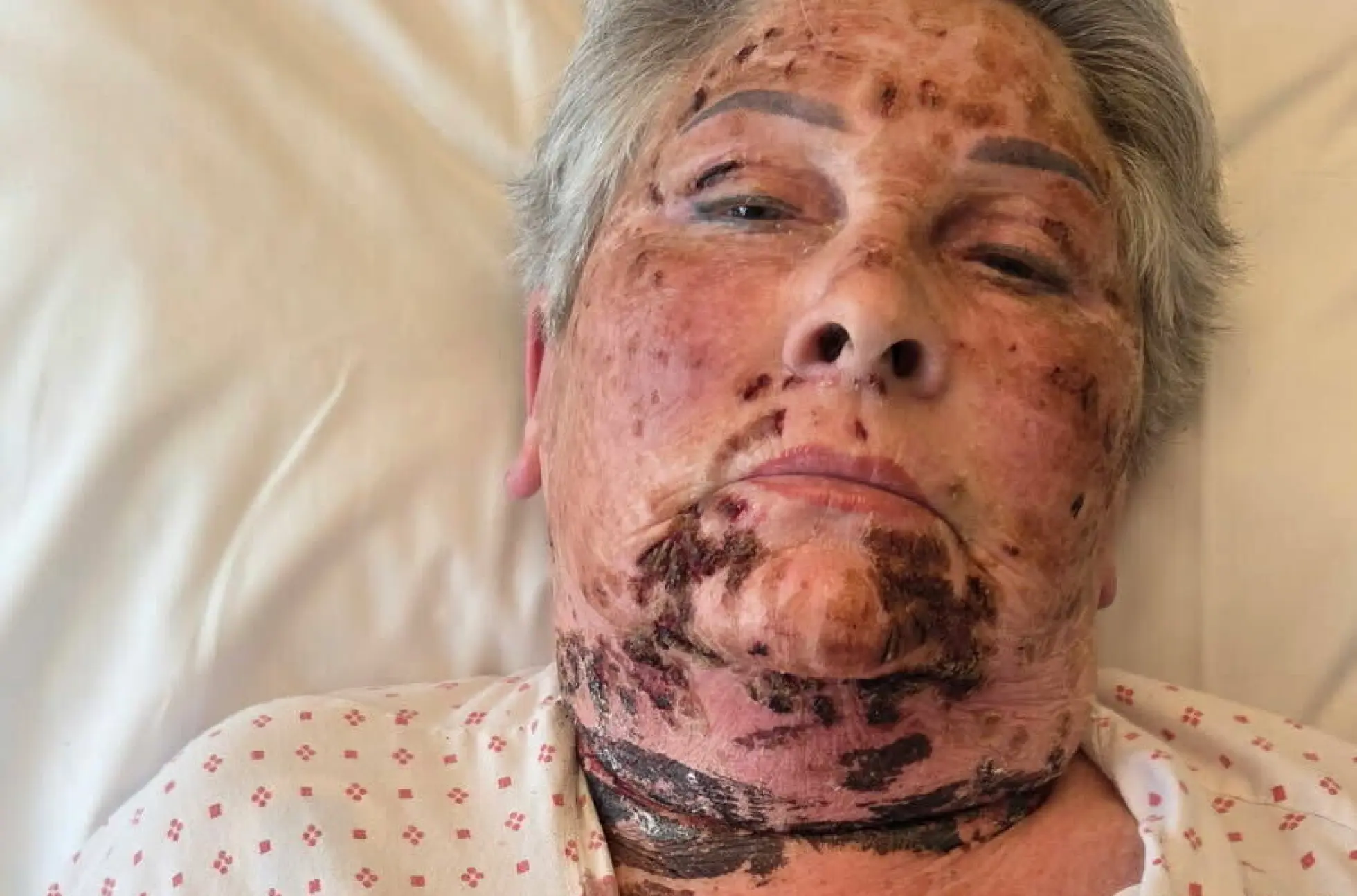
Her face and neck were intensely red, and the sensation was far from what she had imagined when she agreed to the procedure. She says she was told that her skin looked as though it had been sunburned and that the reaction would pass.
At that moment, however, neither Bente nor the people around her could have known how dramatically the situation would develop over the next few days.
What began as an attempt to improve her appearance would soon turn into a frightening medical emergency.
Bente Mauritzen, 68, had originally spent 78,000 Norwegian kroner on a cold-treatment procedure for her abdomen at Klinikk Asena in Stavanger. According to her account, she had been told that the results could take approximately three months to become visible.
When she still did not notice a significant difference after four months, she contacted the clinic.
What happened next eventually led her to a completely different treatment.
According to Bente, the clinic offered her other cosmetic treatments corresponding to the amount she had already paid. The discussion eventually turned toward laser treatment.
Initially, she says, she was interested in treating only her chin.
But the proposed treatment expanded.
Eventually, the plan involved her entire face and neck.
Bente says she did not feel that she fully understood what she was about to experience. She trusted the clinic and believed the professionals knew exactly what they were doing.
Then came the moment she saw herself in the mirror.
She describes being shocked by her appearance, saying that her skin was intensely red and that she wondered how she could possibly go outside looking like that.
The clinic, however, says the procedure was an ordinary laser treatment and that redness was an expected reaction. It also disputes Bente’s description that she received insufficient information beforehand or that the treatment was performed more intensely than she had agreed to.
At the time, Bente had no idea that the disagreement over what happened during the procedure would later become only one part of a much more serious story.
Soon, she began feeling unwell.
The discomfort in her face and neck was accompanied by a growing sense that something was not right. According to Bente, the treated areas were extremely painful.
Then her overall condition began deteriorating.
The following day she was still feeling sick. Over the next few days, the situation became increasingly difficult. She experienced vomiting and diarrhea and eventually struggled to eat and drink.
But perhaps the most frightening part was that she initially did not realize just how serious the situation had become.
She had been told that her skin looked sunburned.
Could this simply be a particularly strong reaction to the treatment?
That question appears to have influenced what happened next.
Bente says she attempted to contact the number she had been given in case problems occurred, but she says nobody answered.
Meanwhile, her condition continued to worsen.
Eventually, she collapsed at home.
She was alone.
Her son Fredrik already knew that his mother had been ill for several days, and he became increasingly worried when he could no longer reach her by phone.
When Bente regained consciousness, she heard her phone ringing.
She was unable to get up normally.
She eventually managed to pull herself partly onto the bed, but the situation had already become critical.
Her family soon arrived.
When they saw Bente’s condition, they realized that this was far more serious than a normal reaction to cosmetic treatment.
An ambulance was called.
She was taken to the emergency department and later transferred within Stavanger University Hospital.
Bente says she remembers very little from the first day in hospital.
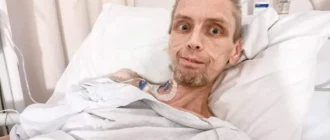
The medical records reviewed by Dagbladet described a severe condition.
She had sepsis and septic shock.
She also had kidney failure.
Doctors found significant changes to the skin on her face and neck. According to infectious-disease specialist and senior physician Lars Kåre Kleppe, the skin problems were considered in connection with the fact that the area had recently undergone laser treatment.
Doctors also found MRSA bacteria in a wound on her neck.
Suddenly, the story was no longer about whether a cosmetic procedure had produced the expected aesthetic result.
It had become a story about a woman whose health had deteriorated to the point where her life was potentially in danger.
Bente says she only later fully understood how serious her condition had been.
She believes that if her family had not become alarmed when they could not reach her, the outcome might have been very different.
And there was another painful detail.
While she was lying in hospital, she was actually supposed to return to the clinic for a follow-up appointment.
Instead, she had to send a message explaining that she could not attend because she was in hospital.
She says she also sent photographs showing her condition and later provided the clinic with medical documentation.
According to Bente, she then felt that communication stopped.
The clinic strongly disputes that characterization.
Klinikk Asena’s managing director, Hicret Alexandra Yerlikaya, told Dagbladet that the clinic had maintained extensive communication with Bente and had also contacted her after learning that she had been hospitalized.
The clinic also says that the laser treatment proceeded normally and that there were no signs of infection when Bente left.
Most importantly, the clinic rejects the conclusion that the treatment itself has been proven to have caused the infection.
After MRSA was discovered, employees and relevant equipment at the clinic were examined. According to the clinic, those tests did not find MRSA among staff or on the equipment examined.
That means an important question remains unresolved.
Bente’s severe illness occurred only days after the laser procedure, and doctors considered the skin infection in the context of the recent treatment.
But the available information does not establish that the clinic was the source of the MRSA infection or that the laser procedure was performed incorrectly.
Bente, meanwhile, has decided not to let the story disappear.
She has filed a complaint with the Norwegian supervisory authority, Statsforvalteren, which has decided to conduct an inspection of the clinic, according to the report.
She is also seeking the return of the 78,000 kroner she originally paid and wants an apology.
For Bente, however, the money is not the only issue.
She says she was frightened to tell her story publicly.
But she also believes that sharing what happened could help other people think more carefully about cosmetic procedures and the risks involved.
And that is where the most important part of her story lies.

This is not simply a story about beauty, laser treatment or an unexpected reaction.
It is a story about how quickly a situation that initially appeared cosmetic and manageable can become medically serious — and about how difficult it can be to understand what is happening when the first symptoms appear.
The final detail is perhaps the most unsettling of all.
Just five days after the laser treatment, Bente Mauritzen was in hospital with sepsis and septic shock, alongside kidney failure. Doctors found MRSA in a wound on her neck, while the clinic maintains that there is no evidence proving the infection came from the clinic or that the treatment was performed incorrectly. The case is now under scrutiny by the Norwegian authorities, leaving the exact cause of the infection an unresolved question.