At first glance, Rebeka looks like any other 12-year-old girl.
She enjoys music. She loves makeup. She likes dressing up and, when her body allows it, dancing. She attends school and is trying to experience as much of an ordinary childhood as possible.
There is, however, a reality hidden beneath those ordinary moments.
For Rebeka, something as simple as being touched can become a source of pain. A small amount of pressure can have consequences that most people could never imagine.
Her mother, Michala, describes her daughter as incredibly fragile on the outside but remarkably strong within. She even compares her to a warrior, because despite everything her daughter faces, Rebeka continues trying to live her life.
Her story is not about giving up.
It is about learning how to live when the smallest things can become difficult.
Rebeka was born with a rare genetic disorder affecting the structure of the skin. In the Czech Republic, only around 250 to 300 people are affected by the broader condition known as epidermolysis bullosa, often described as the “butterfly disease” because the skin can be as fragile as butterfly wings.
But Rebeka’s particular form is even rarer.
And that difference is crucial to understanding what her everyday life looks like.
Children with this condition do not simply have sensitive skin.
Their skin can blister and tear after very little friction or pressure.
Something that would be completely harmless to another child can leave Rebeka with a painful injury.
Getting dressed can require care.
Moving around can be difficult.
Even ordinary physical contact has to be approached carefully.
For her family, this means that everyday life involves constant awareness.
There is no opportunity to simply forget about the illness.
It is always there.
Yet Rebeka refuses to let the condition define every part of her personality.
She is still a schoolgirl.
She attends sixth grade, although she needs the assistance of another person. She can sometimes walk, but only for limited periods and distances. On other days, walking may be impossible, which means she relies on a wheelchair.
Her mother has learned to recognize the differences from one day to another.
Some days are better.
Others are considerably harder.
That uncertainty is one of the most difficult parts of living with a chronic condition.
There is no simple schedule telling Rebeka when she will feel better or when her body will suddenly become more vulnerable.
Her family can only respond to what happens.
And there is another part of the illness that makes her situation even more complicated.
It is not only her skin that can be affected.
The condition can also involve internal areas of the body.
For Rebeka, eating normally is a serious problem.
The family has to be extremely careful because solid food can cause painful blistering in the mouth and oesophagus.
As a result, she has a gastrostomy tube through which she receives nutrition.
For most children, eating is one of the most ordinary parts of the day.
For Rebeka, it can become a medical challenge.
That single difference illustrates just how far removed her daily existence can be from the lives of other children her age.
Yet there are still moments when she can simply be a teenager.
She loves makeup.
She loves music.
And, according to her mother, if her body allowed it, she would happily dance every minute she could.
Sometimes she sings instead.
Sometimes she dances a little, doing only as much as her legs will allow.
Those details are important because they show another side of her story.
The illness may affect what Rebeka can physically do, but it has not erased the things she enjoys.
Her family also tries to create moments that have nothing to do with hospitals, wounds or medical care.
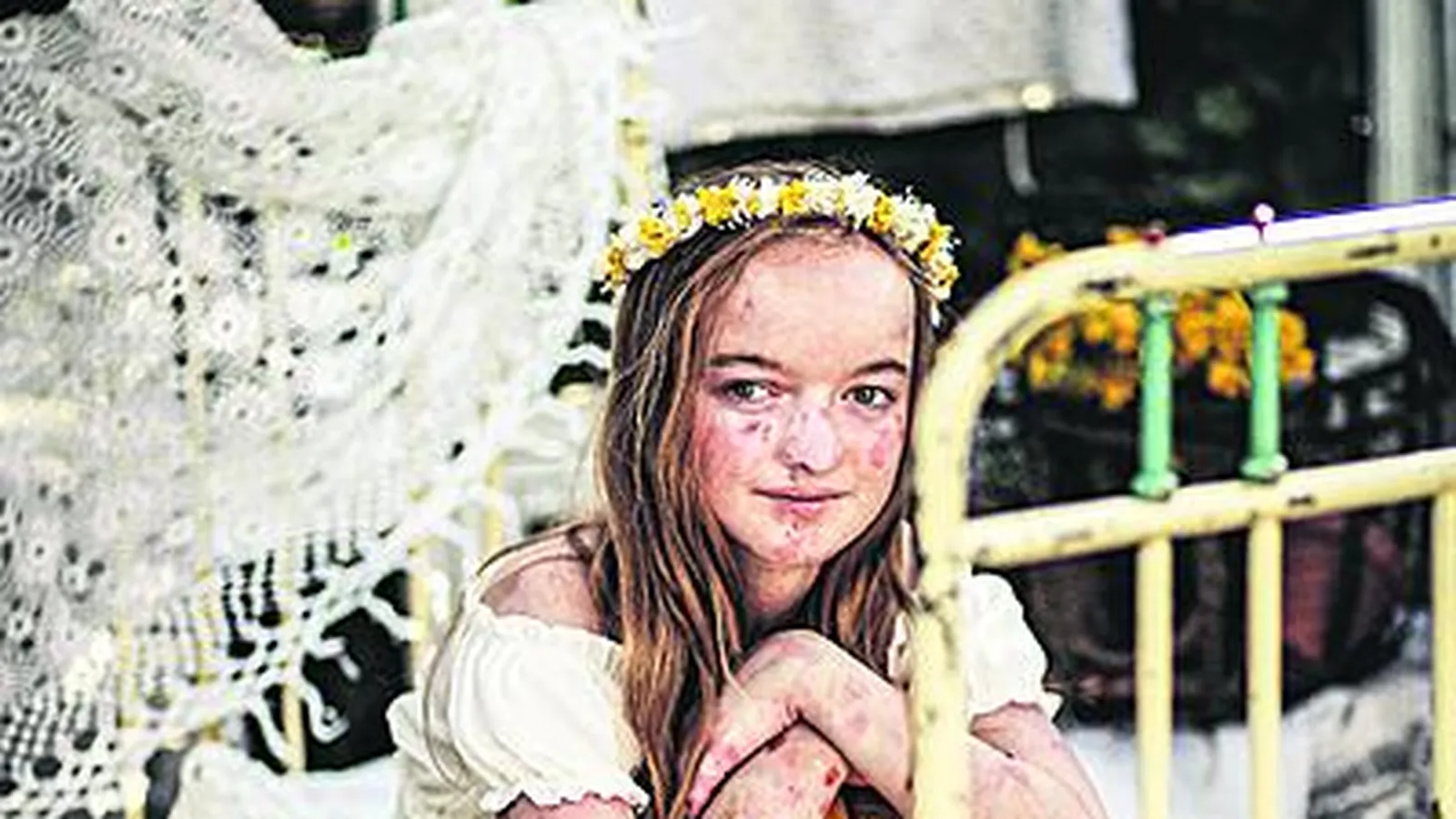
She has taken part in an artistic photo shoot, something she reportedly enjoyed very much. Photographs show a young girl who looks confident and expressive — far removed from the clinical descriptions that usually accompany discussions of rare diseases.
That contrast is striking.
Behind the photographs is a child who must think about things other children rarely have to consider.
But in front of the camera, she can simply be Rebeka.
Her mother’s description of her daughter reflects that same contrast.
She knows how physically fragile Rebeka is.
But she also sees an extraordinary determination.
The condition is incurable, and doctors cannot predict exactly how it will develop in the future. Treatment therefore focuses largely on caring for the blisters and wounds, reducing symptoms and preventing further damage.
For the family, hope therefore comes from several directions.
Medical research continues.
New treatments are being explored.
And Rebeka is currently trying a new healing gel, with her family hoping that it might improve her condition.
They know there is no guaranteed solution.
They also know that medicine continues to change.
That is why they refuse to abandon hope.
Perhaps the hardest thing to understand about Rebeka’s condition is how invisible it can be at first.
A person can look perfectly healthy for a moment.
Then something as ordinary as pressure against the skin can reveal how different their reality actually is.
This is why the comparison with butterfly wings has become so powerful.
The skin is extraordinarily delicate.
But Rebeka herself is anything but weak.
Her story contains an unusual contradiction.
Her body requires extraordinary protection, yet her personality appears determined to push beyond those limitations.
She still has interests.
She still has dreams.
She still wants to laugh, listen to music, dress up and experience life.
And perhaps that is what makes her story so difficult to forget.
It would be easy to focus only on the painful details.
The wounds.
The wheelchair.
The feeding tube.
The limitations.
But that would tell only half of the story.
The other half is a 12-year-old girl who is trying to live rather than simply survive.
Her mother sees that strength every day.
She knows that Rebeka faces something that cannot currently be cured. She knows that even her future is difficult to predict.
But she also sees the girl who loves music, makeup and dancing.
The girl who still wants to participate in school.
The girl who sometimes has better days and sometimes much worse ones.
And the girl who continues to hope.
That hope is perhaps the most important detail of all.
Because the biggest revelation in Rebeka’s story is not simply how rare her illness is.
It is not even the fact that her skin can be damaged by something as slight as a touch.
The real revelation is how much effort goes into creating an ordinary life around such an extraordinary condition.
Rebeka is living with a rare, incurable form of epidermolysis bullosa, in which her skin can blister and tear from minimal pressure. She sometimes needs a wheelchair, receives nutrition through a gastrostomy tube and requires constant care. Yet she continues attending school, enjoying music and makeup, and dreaming of dancing whenever her body allows it.
Her family cannot know exactly what the future will bring.
But for now, they continue looking forward.
They believe medicine may eventually offer better answers.
They are trying new approaches.
And most importantly, they are allowing Rebeka to remain what she has always been beneath the diagnosis:
A child who wants to live, laugh, listen to music and enjoy every moment her fragile body will give her.